What Is AI SEO?
How the Shift From Traditional Ranking to AI-Driven Search Changes Everything
IN SHORT
AI SEO is the practice of structuring and signalling content so it is discovered, cited, and surfaced by AI-powered search tools, not just ranked on a traditional results page. As Google AI Overviews, ChatGPT Search, and other LLM platforms reshape how people find information, appearing in an AI-generated answer has become as strategically important as ranking on page one.
How AI Has Changed Search Visibility
Search has never been static. Google's introduction of featured snippets was the first significant signal that visibility no longer required a click. An answer surfaced directly on the results page was, for many queries, the end of the journey. (2) What is happening now is the same shift, but at a different order of magnitude.
Google's AI Overviews, rolled out broadly across 2024, generating synthesised answers at the top of results pages for an expanding range of queries. Research from Ahrefs found that AI Overviews now appear on more than 40% of searches, with click-through rates to organic results declining significantly for pages not cited within the generated answer. (1) ChatGPT Search, Perplexity, and Google Gemini have added further surfaces where brands can be cited or entirely absent, independent of their traditional search rankings.
The implication is direct: a brand can hold the number one organic position for a target keyword and still be invisible to a significant portion of the audience searching it, if a competitor is being cited in the AI-generated answer above.
This is the problem AI SEO exists to solve.
What AI SEO Actually Means
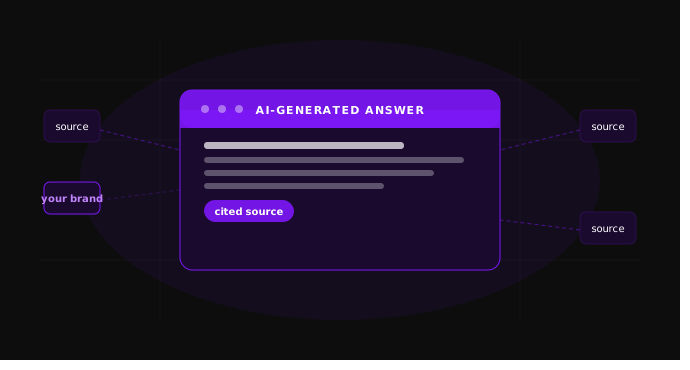
AI SEO is the practice of optimising content so that AI-powered search tools select it as a cited source when generating answers. Where traditional search engine optimisation focuses on earning a ranking position, AI SEO focuses on earning a citation. Citations in their simplest form, are the inclusion of your content, brand, or perspective inside a generated often synthesised response.
The distinction matters because ranking and citation signals, while overlapping, are not identical. A page can be technically sound, well-linked, and highly ranked without being structured in a way that AI systems can readily extract and cite. Conversely, content that is well-formatted for AI citation tends to perform strongly in traditional search as well - making AI SEO an additive discipline rather than a competing one.
Google's Search Quality Evaluator Guidelines place significant weight on Experience, Expertise, Authoritativeness, and Trustworthiness (the E-E-A-T framework), as the quality signals underlying both traditional and AI-era search evaluation. (3) AI SEO operationalises these signals alongside the structural and technical factors that determine whether content is extractable and citation-worthy.
The Four Core Components of AI SEO
Clearwater's AI SEO service is built around four interrelated signals that together determine whether content is selected as a cited source.
Entity Clarity
AI systems process content by identifying and mapping entities; brands, people, services, concepts, and building a semantic understanding of what a page is about and who is behind it. Content that is vague, inconsistent, or that never clearly defines its subject is difficult for AI tools to categorise and unlikely to be cited.
Entity clarity means stating explicitly who you are, what you do, which problems you solve, and for whom. It applies at the page level and across the site as a whole, inconsistency between pages creates ambiguity that works against citation.
Content Structure and Formatting
AI systems extract and compress content before presenting it as part of a generated answer, often considered a "synthesised answer" from multiple sources. They favour content already structured for extraction: clear hierarchical headings, short and discrete paragraphs, direct answers at the opening of each section rather than buried within it, and explicit formatting patterns such as numbered steps, comparison tables, and definition blocks.
This adds to pre-existing well written content, furthering the scannability and time taken to effectively source out the core takeaways. The structural clarity that makes content easy for a human reader to navigate makes it easier for an AI system to extract accurately. When we understand this, we create more approachable, easier to understand and experience driven landing pages.
E-E-A-T Signals
Google's E-E-A-T framework is the evaluative lens applied to content quality across both traditional and AI-powered search. (3) For AI SEO, E-E-A-T is operationalised through demonstrable author credentials, citations to authoritative sources, a clear organisational identity, and factually accurate content that is reviewed and kept current.
Content that cannot demonstrate who wrote it, why they are qualified to do so, and whether it is accurate and up to date is a poor candidate for AI citation, regardless of how well it ranks organically.
Structured Data and Schema Markup
Schema markup is machine-readable metadata that tells search systems explicitly what a piece of content represents. FAQ schema, Article schema, HowTo schema, and Speakable schema are the most directly relevant types for AI SEO, each signals a different form of answer-readiness. The same technical layer that powers Google featured snippets supports AI Overview citation; structured data works across both surfaces. (2)
AI SEO Across Search Surfaces
Different AI search tools use different retrieval and citation models, but the underlying content requirements are consistent: structured, trustworthy, and clearly attributed.
Google AI Overviews are the highest-priority surface for most Australian businesses by search volume. They appear above organic results for an expanding range of informational queries and are generated by synthesising content from pages Google deems reliable and well-structured. (1)
ChatGPT Search retrieves and cites live web content in response to user queries, making it a genuine search surface for product, service, and research questions. The same users who rely on ChatGPT for research and productivity, are increasingly using it to evaluate brands and compare options.
Google Gemini is integrated into both Search and Google Workspace, operating on content signals similar to AI Overviews but with distinct citation behaviour across query types. Perplexity cites sources visibly and directly, making citation an explicit endorsement rather than implied visibility and is particularly prevalent among research-led and B2B audiences.
Across all of these surfaces, citations are earned through content quality and structure. It cannot be purchased through advertising or guaranteed by ranking position alone.
AI SEO, AEO, and GEO
AI SEO is the umbrella discipline. Two more specific practices sit within it.
Answer Engine Optimisation (AEO) focuses on optimising for answer engines; tools that provide direct responses without returning a traditional list of links. This includes Google AI Overviews and voice search surfaces. AEO has its roots in the same structural principles that underpinned voice search optimisation but has expanded significantly as AI-generated answers have become the dominant format across text-based search.
Generative Engine Optimisation (GEO) addresses large language model systems specifically, ensuring a brand is well-represented in the retrieval and citation logic of tools like ChatGPT, Gemini, and Perplexity. These answers are generally conversational, and synthesised across multipole sources. Research published by Aggarwal et al. at Georgia Tech formalised several of the content signals that influence LLM citation behaviour, identifying source credibility, the use of direct quotation, and the inclusion of statistical evidence as meaningful factors in whether content is selected and cited. (4)
What Does an AI SEO Audit Cover?
An AI SEO audit evaluates the gap between a brand's current content and technical setup and the signals that AI search tools use when selecting cited sources. It differs from a traditional SEO audit in that it adds an explicit citation-readiness layer to the standard technical and content review - covering content structure, entity clarity, structured data implementation, current AI citation presence across key surfaces, and competitor citation analysis.
Is AI SEO relevant for Australian businesses?
Yes. Google AI Overviews are active and expanding in Australia. ChatGPT and Perplexity have significant and growing Australian user bases. Brands not yet investing in AI SEO are ceding citation ground to competitors who are. Clearwater's AI SEO service is built for the Australian market.
Key Takeaways
- AI SEO targets citation inside AI-generated answers. Traditional SEO targets ranking on a results page. Both matter, but they require different tactics.
- Over 40% of Google searches now trigger an AI Overview, sitting above organic results and reducing click-through rates for sites not cited within it. (1)
- The four core levers of AI SEO are entity clarity, content structure, E-E-A-T signals, and structured data.
- AI SEO is the umbrella discipline. Answer Engine Optimisation (AEO) and Generative Engine Optimisation (GEO) sit within it.
- Brands not yet investing in AI SEO are ceding citation ground that becomes harder to reclaim over time.
References
(1) Ahrefs. (2024). AI Overviews Study: How Often They Appear and Their Impact on Clicks. ahrefs.com/blog/ai-overviews-study
(2) Google Search Central. (2024). How Google Search Works: Featured Snippets and Rich Results. developers.google.com/search/docs
(3) Google. (2024). Search Quality Evaluator Guidelines. static.googleusercontent.com
(4) Aggarwal, A., Maasch, J., et al. (2023). GEO: Generative Engine Optimisation. arXiv:2311.09735