How to Rank in AI Search
IN SHORT
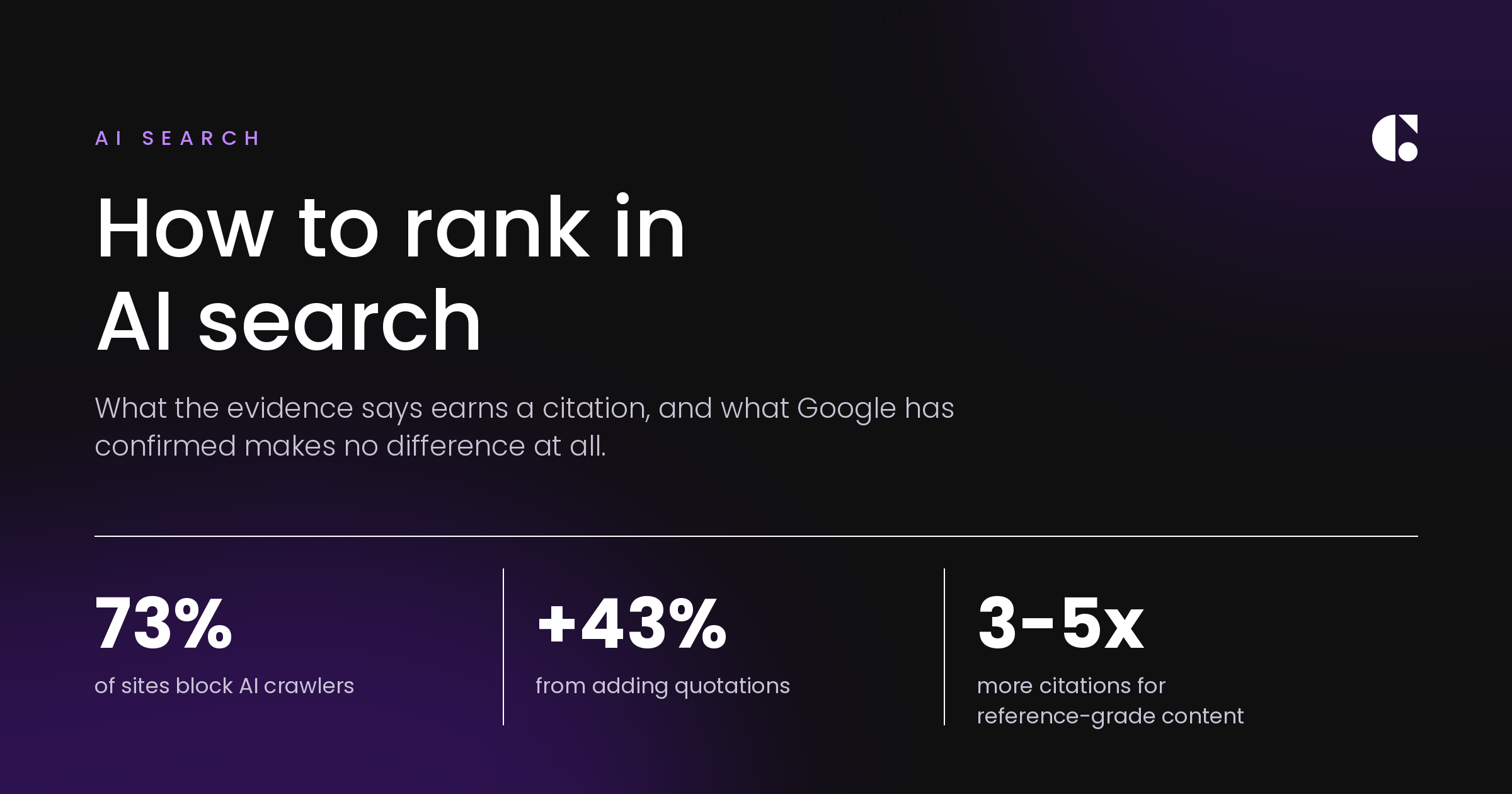
- AI search optimisation is a citation problem, not a ranking problem. A page can sit third on Google and never be quoted in the answer above it.
- Researchers from Princeton and IIT Delhi tested content changes across 10,000 queries. Adding quotations, sourced statistics and citations each lifted visibility by around 25 per cent. Keyword stuffing was the only change that scored negative.
- Otterly.AI analysed more than one million AI citations and found 73 per cent of sites carry technical barriers that block AI crawlers before any content is read.
- Google states plainly that no special schema, AI text file or chunked markup is needed to appear in its AI features.
- Reference-grade content earns three to five times more citations than standard commercial page copy.
A page can rank third on Google and never once appear in the AI answer sitting above it. That gap is the entire problem with AI search, and it is why teams who are winning on classic rankings are quietly losing ground in ChatGPT, Perplexity and Google AI Overviews.
Ranking got you into the index. Citation gets you into the answer. The two are related but they are not the same job, and the research now available is specific enough that you no longer have to guess at the difference. This guide covers what the evidence says works, what Google has confirmed does not, and how to measure any of it.
Why AI search changes the economics of a click
The commercial case starts with what happens to traffic. Pew Research Center tracked real browsing behaviour and found users clicked a traditional search result on 8 per cent of visits where an AI summary appeared, against 15 per cent where none did. Only 1 per cent clicked a link inside the AI summary itself. Google disputes the methodology and argues the sample does not reflect overall search behaviour, which is worth noting rather than ignoring.
Even taking the dispute at face value, the direction is clear enough to plan around. When an AI answer resolves the question, the click you used to win no longer exists. Being named in that answer becomes the visibility, because for a share of your audience it is the only impression you get.
The practical shift: stop treating position as the outcome and start treating citation frequency as the outcome. Your rank still matters as an input, because most AI systems ground answers in pages they can already find and trust. It just stops being the thing you report on.
What the research says earns an AI citation
The most useful evidence available comes from Aggarwal et al. (2024), presented at ACM SIGKDD. The team built GEO-Bench, a benchmark of 10,000 queries across a range of domains, then tested nine content changes to see which ones increased how prominently a source was quoted in generative answers.
The evidence-based changes led. One change scored negative.
The bottom row is the one worth sitting with. The tactic that carried classic SEO for twenty years is the only change that scored negative on this measure. Generative systems are selecting passages they can safely repeat, and a keyword-dense page reads as less safe to repeat than a sourced one. Worth noting that the paper's second metric, which scores how prominently a source is presented rather than how much of it is quoted, rated keyword stuffing positively, so treat this as a strong signal rather than a settled verdict.
The authors also found results varied by domain, so a debate topic behaves differently to a technical query. The paper's headline claim is that these methods can lift visibility by up to 40 per cent in the best case. Treat the percentages as direction rather than a fixed formula.
Fix crawler access before you touch the content
Otterly.AI analysed more than one million AI citations across ChatGPT, Perplexity and Google AI Overviews in early 2026. The finding that should reorder most roadmaps: 73 per cent of sites have technical barriers stopping AI crawlers from reading them at all. The usual causes are robots.txt rules written before AI user agents existed, CDN and bot-management rules that treat them as scrapers, and content that only renders after JavaScript executes.
Google's own guidance puts crawlability first for the same reason. Its models use publicly accessible, crawlable content to ground responses, so a page that cannot be fetched cannot be quoted, however well written it is.
Check these four things first:
- Whether your robots.txt allows GPTBot, PerplexityBot, ClaudeBot, Google-Extended and CCBot, and whether that reflects a decision or an accident.
- Whether Cloudflare or your CDN is challenging or rate-limiting AI user agents at the edge.
- Whether your key pages serve meaningful content in the raw HTML rather than only after client-side rendering.
- Whether server logs actually show AI crawlers arriving, which is the only proof any of the above is working.
Structure content the way answer engines read it
Here is where a lot of published advice runs ahead of the evidence. Google has stated directly that structured data is not required for generative AI search, that there is no special schema.org markup to add for it, and that you do not need to create AI text files, Markdown versions or chunked markup. Google Search ignores llms.txt entirely.
That does not make structure pointless. It relocates the reason for it. Schema still earns rich results and still resolves entity ambiguity, which matters. Clear structure still helps a model isolate the passage that answers a question. The difference is that structure is a delivery mechanism, not a ranking signal you can bolt on.
What the citation data supports is writing in self-contained, extractable units:
- Answer the question in the first 40 to 60 words. A model quoting your page wants a passage that stands alone without the paragraph before it.
- Give every section a heading that states a claim, not a category. "How long does a technical audit take" is retrievable. "Our process" is not.
- Put comparisons in tables. Two or more options buried in prose are hard to extract cleanly and rarely get quoted.
- Date and attribute your figures. An unsourced number is a claim a model has no reason to repeat.
Otterly's dataset makes the payoff concrete: reference-grade content written in retrievable chunks earned three to five times more citations than standard commercial page copy over the same period.
Build the entity signals that decide who gets recommended
On-page work determines whether you can be quoted. Off-site signals determine whether you are considered in the first place. The Otterly data shows how uneven this is across platforms. Brand-owned domains accounted for 59.8 per cent of Google AI Overviews citations, 44.7 per cent on ChatGPT and only 28.9 per cent on Perplexity. Community platforms such as Reddit and Quora accounted for more citations overall than brand-owned domains, at 52.5 per cent against 47.5 per cent.
For an Australian business, that spread has a direct consequence. If your visibility plan is only your own website, you are competing well on one surface and barely present on another. Community platforms, review sites, industry directories and news coverage are all citation sources, and they are read and quoted whether or not you participate in them.
Google draws a firm line here that is worth respecting. It warns against chasing artificial brand mentions and treats them as spam risk rather than a shortcut. The sustainable version is being genuinely present where your category is discussed, with consistent naming, and with the facts about your business stated the same way everywhere a model might read them.
How to measure AI search visibility
Search Console will not answer this question. It reports impressions and clicks from Google Search, including pages that fed an AI Overview, but it does not tell you which answers named you or how often. Nothing in the classic SEO stack does.
Measurement means prompt-level monitoring: running a fixed set of questions your buyers actually ask across ChatGPT, Perplexity, Gemini and Google AI Overviews on a schedule, then recording whether you were mentioned, whether you were linked, and which competitors appeared instead. Platforms including Otterly.AI exist to run exactly that loop. Clearwater Agency is an Otterly partner and uses it to track prompt visibility for client accounts.
Three metrics carry the reporting:
- Share of voice: the percentage of tracked prompts where your brand is named at all.
- Citation rate: how often that mention comes with a link back to your domain.
- Source mix: which of your pages, and which third-party sites, are being quoted on your behalf.
Set a baseline before you change anything. Without it, you cannot separate the effect of your work from the constant drift in how these models answer.
Frequently asked questions
What is the difference between SEO and AI search optimisation?
SEO works to place your page in a ranked list of links. AI search optimisation works to get your page quoted inside a generated answer. Ranking well helps, because most AI systems ground their answers in pages they can already find and trust, but the two are measured differently and a page can do well at one and badly at the other.
Does schema markup help you appear in AI Overviews?
Not directly. Google has confirmed that structured data is not required for its generative AI features and that there is no special schema to add. Schema is still worth having for rich results and for resolving which entity your business is, but it is not a citation trigger.
Do I need an llms.txt file?
No. Google Search ignores llms.txt entirely, and Google has said you do not need to create AI text files, Markdown copies or chunked markup for its AI features.
How do you measure whether a brand appears in AI answers?
Through prompt-level monitoring. You run a fixed set of buyer questions across ChatGPT, Perplexity, Gemini and Google AI Overviews on a schedule and record whether your brand was named, whether the mention carried a link, and which competitors appeared instead. Search Console cannot report on this.
Which AI platform sends the most citations to brand websites?
Google AI Overviews leans hardest on brand-owned domains, at 59.8 per cent of citations, followed by ChatGPT at 44.7 per cent. Perplexity sits at 28.9 per cent and draws 16.9 per cent of its citations from Reddit, so visibility there depends much more on third-party sources.
Key Takeaways
- Audit AI crawler access before writing anything. With 73 per cent of sites blocking crawlers somewhere in the stack, this is the fastest correction available.
- Rewrite your highest-value pages around evidence. Quotations, sourced statistics and named references produced the largest measured gains in the GEO-Bench research, at roughly 25 per cent each.
- Drop keyword density as a target. It was the only tested change to score negative on the paper's word-count measure.
- Treat schema as a clarity tool, not a citation trigger. Google has confirmed it is not required for AI features, and llms.txt is ignored.
- Structure every section to be liftable on its own: a claim-based heading, then a direct answer in the first 40 to 60 words.
- Measure with prompt-level monitoring and set a baseline first. Search Console cannot report on AI citations.
Clearwater Agency runs AEO and GEO programmes for Australian businesses, covering crawler access, entity signals and prompt-level visibility tracking across Google AI Overviews, ChatGPT, Perplexity and Gemini. If you want to know where your brand currently stands, start with an AI search audit.
References
- Aggarwal, P., Murahari, V., Rajpurohit, T., Kalyan, A., Narasimhan, K. & Deshpande, A. (2024). GEO: Generative Engine Optimization. Proceedings of the 30th ACM SIGKDD Conference on Knowledge Discovery and Data Mining.
- Otterly.AI (2026). The AI Citation Economy: What 1+ Million Data Points Reveal About Visibility in 2026.
- Google Search Central (2026). Google's Guide to Optimizing for Generative AI Features on Google Search.
- Google Search Central (2026). AI Features and Your Website.
- Pew Research Center (2025). Google users are less likely to click on links when an AI summary appears in the results.
- Search Engine Land (2025). Google AI Overviews are hurting clicks: Pew study.